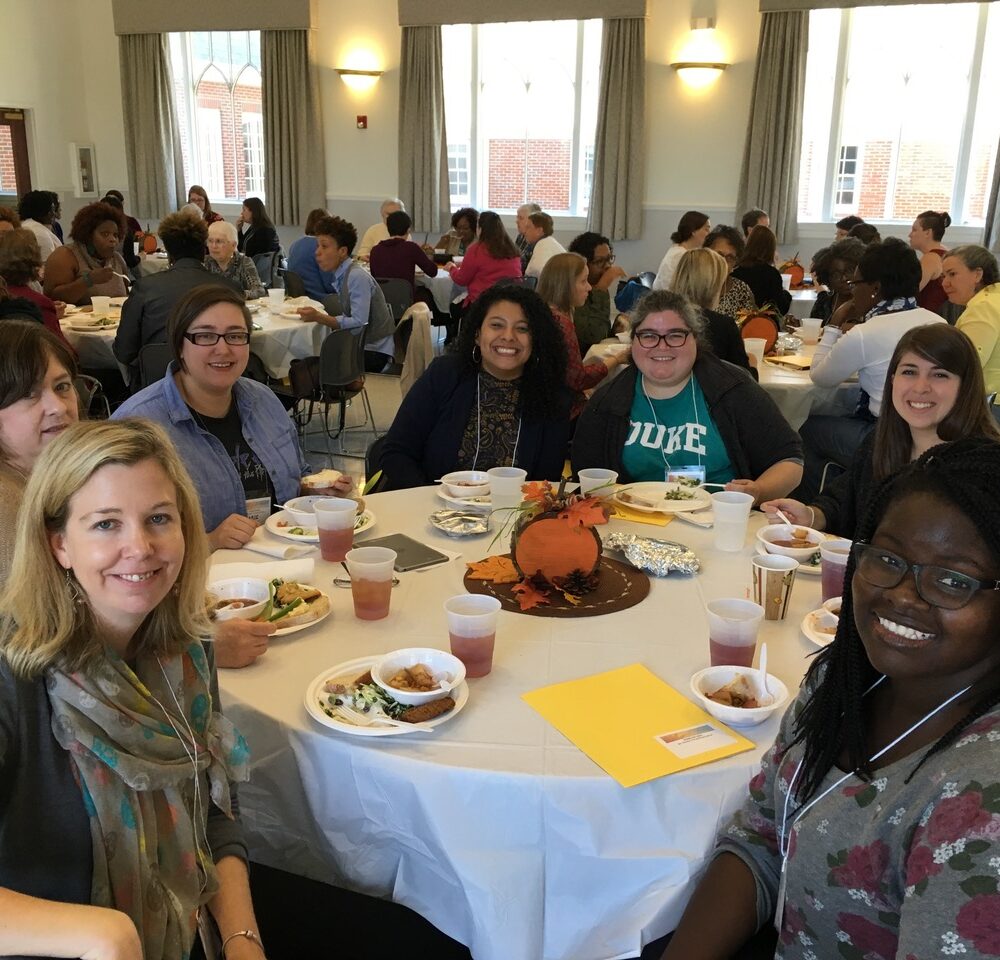
As we prepare for the Homegrown Women’s Preaching Festival on October 2-3, 2025, we are excited to share an interview with Rev. Carla Gregg-Kearns, co-founder of the festival. Conducted by Anna Blair, an intern at RCWMS who credits women preachers as a vital part of her upbringing, this conversation explores the festival’s history and this year’s gathering. We hope it will inspire you to support the HOMEGROWN: NC Women’s Preaching Festival as we amplify the voices of women clergy and faith leaders in North Carolina.
For more information and to register for this year’s Homegrown Women’s Preaching Festival, please visit us at https://ncwomenpreaching.com/. To listen to an excerpt of the interview, click here.
Anna: What was the original inspiration behind starting the Homegrown Women’s Preaching Festival?
Rev. Carla: Reaching all the way back to the fall of 2011, the North Carolina legislature had just passed the law to put Amendment One as a referendum on the ballot in the state of North Carolina, and for folks who might not remember or don’t know, Amendment One was the new amendment defining marriages as between a man and a woman. And when the legislature said it was going to be on the ballot, I kind of knew how that vote was going to go come May of 2012, and so I really just went into a depression. I mean, it was very, very difficult, very sad for me.
I happened to just be in a couple of different situations where there were women who were preaching. So there was a person named Laura Benson who worked for the Partnership for Children in Durham. I heard her preaching at some event. There’s a UCC pastor, now retired, named Julie Peeples, who was in Greensboro for a long time. I heard her preaching, and there was Reverend Diane Jackson Davis, who’s also a UCC pastor, who I heard preaching. All very different women, very different work situations, but in that fall, all of them were these lights for me. They were truly lights in a time that was very, very difficult, and as I experienced that in different ways from them, I thought, “How could this be for everybody, not just for me? How can we do something and make this bigger and brighter for other people who might be feeling the same way that I am?”
I mentioned it to a friend, to Lori Pistor, and another friend at the time who was also a minister in Durham, Elizabeth M., and they both said, “Okay, let’s do it! Let’s see what we can make happen.” And so from that core group, we started dreaming about what it would look like to bring together women as featured preachers, but also women as the community at a preaching festival to hear the Word of God proclaimed in ways that were really life-giving. So I will say one of the important things to me has always been that it’s a festival and not a conference. I kind of come back around to that frequently. If I hear people say something about a Preaching Conference, I’m like, no, no, no, no, it’s not a conference. It’s a festival, and the reason I’ve been insistent about that is that I really want it to be a celebration. It’s not just about learning, but it is about learning, but it’s also about celebration and community and joy together.
Anna: Could you elaborate on why this specific focus on local, diverse voices is so important?
Rev. Carla: I think because, as I mentioned, the names of Diane and Laura and Julie, none of those folks were famous. They don’t have best-selling books. They’re not headliners at major preaching events around the country or around the world, but they were each beautiful, prophetic, and profound in their own distinct ways. And I was reminded once again that that sort of wisdom and creativity and genius is all around us. It’s not just in the people that tend to get platformed, right? There are a lot of certain voices in the religious space that tend to get platformed and amplified. And I really wanted to shift and challenge that with the festival for people to recognize, hey, there might be somebody you’ve never heard of serving a church with 50 people in a small town in eastern North Carolina, who is powerful in their preaching. So yeah, just really trying to bring all of that together, and also this sense of it being organic, really coming up from the people who were creating it. Not just, Oh, we’re gonna grab people from somewhere else, bring them in for a moment, send them back out, but we’re creating this together. We’re participating in this together, and we are intentionally lifting up voices that don’t regularly get platformed or amplified in the preaching and religious space.
Anna: How has the festival’s mission evolved since its inception? And what do you think remains at its core?
Rev. Carla: I don’t know exactly how it’s evolved, except to say it evolves every year, and it’s different every year. I’m never sure exactly how it’s going to come together, or exactly what people might experience in the moment. Over the course of those two days, we’ve done different things. We’ll try this, we’ll add this, or take something else away. So it’s constantly changing like that, sort of like a living organism I guess. I might say not that there’s been some drastic, you know, arc of what the festival started as and looks like today, but I think that idea of really trying to stay organic has continued to be true, and it continues to be a vital and living thing. It’s always been collaboratively planned, which is an, I don’t know if arduous is the right word, but it’s a complicated, beautiful process, but it takes time, and it takes work together to be able to do that. So that’s also something that’s always been a part of it, because I also think that’s what makes it better, and what makes it what it is, you know, from year to year. So based on who is part of the planning committee, that really influences what’s going to happen at the festival- and now those different folks coming-together is what creates the festival.
Anna: What do you look forward to most about this year’s festival?
Rev. Carla: I think there are two things. One is the surprises that always happen. You just never know. You do all of this planning to help create a framework, but then you don’t know what all the participants are going to bring to it, because it’s not just what you plan and the workshop leaders or the preachers that are the festival. It’s also made up of all the people who attend and the things that they contribute to it. And that every year is a surprise. You don’t know what’s going to be really moving, or what’s going to be challenging, what’s going to be the thing you carry with you from that time. So I think I always look forward to the surprises that are going to happen. I’m also really looking forward to this year, Dr. Chelsea Yarborough, who was a student preacher with the festival back when she was a student at Wake Forest University School of Divinity I’m not exactly sure what the date was, but I think that was about a decade ago. She was definitely a part of the early years of the festival, and so it just feels really exciting, really, you know, beautiful to have her journey sort of come back around or intersect again with the festival now as a professor, and so I’m really, I’m just excited to have her back in that, in that role. Anna: The preaching we’re gonna have this year, I think it’s gonna be phenomenal. And then thinking about 2025, what unique needs do you feel the festival addresses for clergy women in North Carolina and beyond?
Rev. Carla: What we have discovered year after year is that there are still a lot of clergy women who feel isolated in their ministries; they might be serving in places where there’s not another female pastor anywhere in their circles. They might be serving in a more urban context, but still feel disconnected from others in their ministry. And so I think one of the things that the festival continues to address is bringing the clergy women together to have that kind of connection and community with one another, which seems really important, especially for those who are isolated, and for those who’ve never been in a community of clergy women or who’ve never seen themselves as part of that kind of larger whole. It’s just, it’s been really powerful. There are lots of clergy women who’ve only ever heard themselves preach, and still to this day, you know that they were the first woman preacher they ever heard. And so it still, I think, serves that purpose. It also helps us to see what’s possible. It really does bring, I think, an energy, maybe a re-energizing to folks’ ministry when they can see, “Oh, wow.” You know, what’s out there? What are people doing? How are they utilizing this? It can just be a real space to share and to be inspired and to have things to carry forward in your own ministry. For more information on sponsorship packages and how you or your affiliated institution can become a sponsor, simply email us at info@rcwms.org, contact Anna personally at anna@rcwms.org, or make a contribution on our website, https://rcwms.org/donate/


Leave a Reply